
Travel Brain Reset Calculator
How much will your next trip reboot your mind?
Answer 3 quick questions about your planned travel style to calculate your estimated "Brain Reset Score" and see which neurological benefits you'll maximize.
Question Text
Calculating...
Analyzing your travel inputs...
Pro Tip for You:
Tip goes here.
Ever come back from a trip feeling like you’ve been rebooted? That lightness in your chest isn’t just vacation fatigue lifting. It’s biology. When you step off the plane or drive past the city limits, your brain starts shifting gears in ways that science is only beginning to fully map out. We often think of travel as a break from work, but for your mind, it’s actually an intense workout. It challenges your neural pathways, forces you to adapt, and physically changes how you process information.
If you’re planning a quick escape this summer, understanding what happens inside your skull might change how you pack your bags-and how you spend your time there. This isn’t about collecting stamps in a passport; it’s about collecting new perspectives. Let’s look at the hard science behind why getting away feels so good.
The Stress Circuit Breaker
Your daily routine is comfortable, but comfort can be costly. When you stay in the same environment, doing the same tasks, your brain relies on autopilot. This efficiency saves energy, but it also keeps your stress hormones, particularly cortisol, at a steady, often elevated level. Cortisol is useful in short bursts-like when you’re running from a bear-but chronic exposure shrinks parts of your brain responsible for memory and emotional regulation.
Cortisol is a steroid hormone produced by the adrenal glands in response to stress. High levels over long periods are linked to anxiety, weight gain, and impaired immune function.
Travel acts as a circuit breaker. Research published in the journal Annals of Behavioral Medicine showed that even anticipating a vacation lowers cortisol levels. By the time you arrive, your body begins to downregulate the stress response. You aren’t just escaping your inbox; you’re chemically altering your state of being. This drop in stress allows the hippocampus-the part of your brain involved in learning and memory-to recover and grow. It’s not magic; it’s homeostasis returning to a healthier baseline.
Neuroplasticity and the Novelty Boost
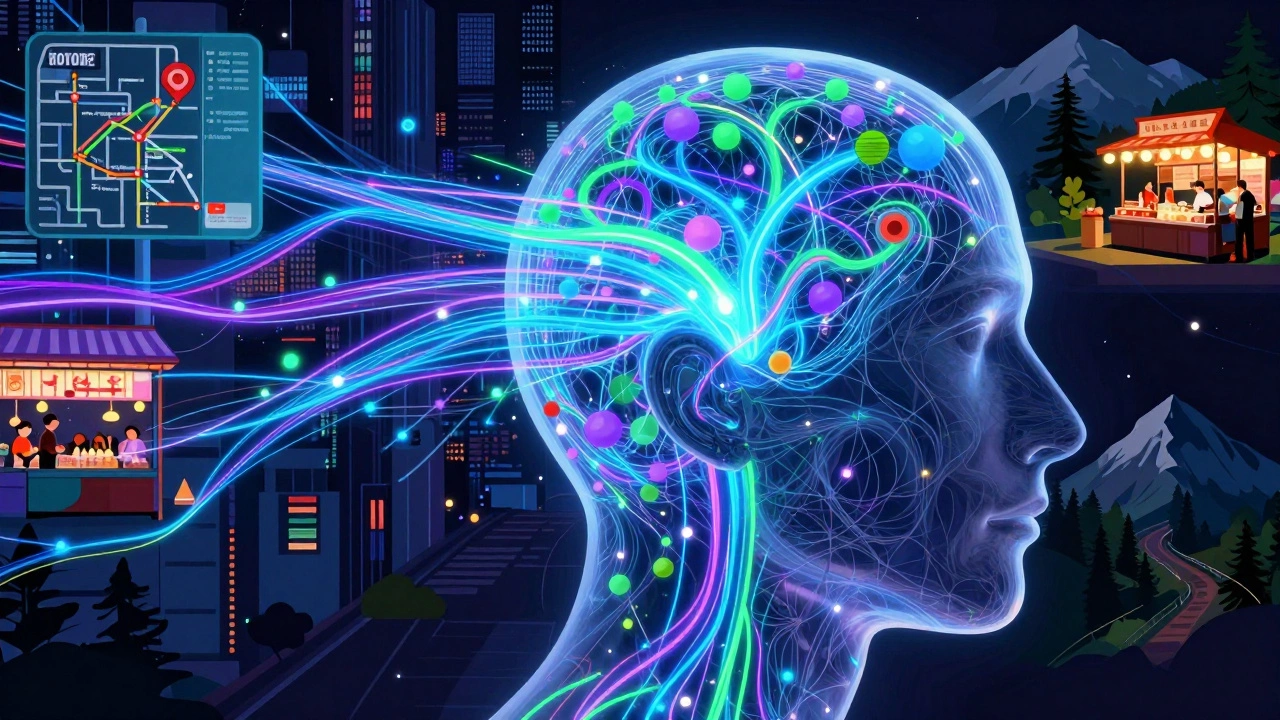
Here is where things get exciting. Your brain has a trait called neuroplasticity. This is its ability to reorganize itself by forming new neural connections throughout life. Neuroplasticity thrives on novelty. When you navigate a subway system in Tokyo, order food in a language you don’t speak, or hike a trail you’ve never seen, your brain lights up. It has to work harder than usual to process these unfamiliar stimuli.
This effort triggers the release of neurotransmitters like dopamine and norepinephrine. Dopamine drives motivation and pleasure, while norepinephrine sharpens focus. Together, they enhance your ability to learn. Studies using MRI scans have shown that people who travel frequently have more complex neural networks in areas associated with spatial awareness and problem-solving. Essentially, traveling makes you smarter. It forces your brain to build new roads instead of driving down the same worn-out highway every day.
Cognitive Flexibility and Empathy
It’s not just about raw processing power; it’s about how flexible your thinking becomes. Cognitive flexibility is the mental ability to switch between thinking about two different concepts, and to think about multiple concepts simultaneously. When you immerse yourself in a culture different from your own, you practice this skill constantly. You have to adjust your expectations, interpret non-verbal cues differently, and suspend judgment.
A study from Yale University found that individuals who spent significant time living abroad scored higher on tests of creativity and open-mindedness. They were better at solving problems that required unconventional approaches. This extends to empathy. Understanding how others live, eat, and celebrate humanizes abstract differences. You start seeing the world through a wider lens, which reduces prejudice and increases social intelligence. This is why travelers often return with a deeper appreciation for diversity-not because they read about it, but because their brains adapted to it.
The Power of Anticipation and Memory
We tend to underestimate the value of planning. The joy of travel doesn’t start when you leave; it starts when you book. Psychologists call this "anticipatory utility." The excitement of imagining your trip releases dopamine well before the event occurs. This prolonged positive emotion can boost mood for weeks leading up to departure.
Once you’re back, the memories you formed continue to serve you. Unlike material purchases, which lose their novelty quickly (a phenomenon known as hedonic adaptation), travel memories remain vivid and rewarding. Each time you recall a stunning sunset in Santorini or a delicious meal in Mexico City, your brain reactivates those positive neural pathways. These memories act as a reservoir of happiness you can draw from during stressful times back home. They remind your nervous system that calm and wonder are possible states of being.
| Factor | While Traveling | During Routine |
|---|---|---|
| Cortisol Levels | Decrease significantly | Often chronically elevated |
| Neural Connectivity | Increases due to novelty | Stagnant or decreasing |
| Cognitive Flexibility | Enhanced by adaptation | Limited by habit |
| Mood Regulation | Boosted by dopamine/serotonin | Dependent on daily stressors |

Practical Ways to Maximize Brain Benefits
You don’t need to circumnavigate the globe to reap these rewards. Even a weekend getaway can trigger positive neurological changes if you approach it intentionally. Here is how to optimize your trip for mental health:
- Embrace Discomfort: Don’t stick to the hotel room. Get lost in a new neighborhood. The mild stress of navigation builds resilience and spatial memory.
- Disconnect to Reconnect: Constant digital stimulation prevents deep relaxation. Put the phone away. Boredom is crucial for the brain’s default mode network, which processes emotions and consolidates memories.
- Engage All Senses: Smell the spices, taste the local fruit, listen to the street music. Multi-sensory experiences create richer, more durable memories.
- Learn Something New: Take a cooking class, try a local sport, or learn basic phrases in the local language. Active learning stimulates neurogenesis (the growth of new neurons).
For example, if you’re visiting a nearby city like Montreal or Quebec City, don’t just eat at familiar chains. Find a small café, order something you can’t pronounce, and talk to the barista. That small interaction forces your brain out of its comfort zone and into a state of active engagement.
Pitfalls to Avoid
Not all travel is restorative. If you schedule every hour of your trip, turning your vacation into a checklist of sights, you may increase stress rather than reduce it. This is "performative travel," where the goal is content creation or box-ticking rather than immersion. Your brain detects this pressure and responds with anxiety, not relief.
Also, beware of jet lag and sleep deprivation. While novelty is good, exhaustion is bad. Lack of sleep impairs cognitive function and negates the benefits of reduced cortisol. Prioritize rest. A slow morning with coffee on a balcony does more for your prefrontal cortex (the decision-making center) than rushing to three museums in four hours.
Does stayingcationing provide the same brain benefits as traveling?
Yes, if you introduce enough novelty. The key factor is breaking routine and engaging with new environments. Exploring a new part of your own city, trying a new hobby, or changing your daily commute can trigger similar neuroplastic responses. However, physical distance often helps psychologically detach from work-related stressors, making traditional travel slightly more effective for reducing cortisol.
How soon after travel do brain benefits appear?
Some benefits, like reduced cortisol and increased dopamine, begin almost immediately upon anticipation and arrival. Structural changes, such as increased gray matter density in the hippocampus, take longer and depend on the frequency and depth of travel experiences. Consistent travel over months or years yields the most significant long-term cognitive improvements.
Can solo travel be better for the brain than group travel?
Solo travel often requires higher levels of problem-solving and decision-making, which can enhance cognitive flexibility and self-reliance. However, group travel offers social bonding benefits, releasing oxytocin. Both are valuable. Solo travel pushes independence; group travel strengthens connection. The best choice depends on whether you need mental challenge or social restoration.
Why do I feel sad after coming back from a trip?
This is known as "post-vacation blues." It occurs because your brain has experienced high levels of dopamine and novelty, then suddenly returns to a lower-stimulation routine. The contrast creates a temporary dip in mood. To mitigate this, integrate elements of your trip into your daily life-cook a dish you learned, keep a souvenir visible, or plan the next adventure soon.
Does nature travel help the brain differently than city travel?
Yes. Nature travel engages the parasympathetic nervous system more deeply, promoting profound relaxation and lowering blood pressure. City travel stimulates cognitive flexibility and sensory processing. For stress reduction, nature is superior. For creativity and mental agility, urban exploration with novel cultural inputs may be more effective. Ideally, combine both.