
All-Inclusive Vacation Cost Calculator
Compare Your Costs
See if an all-inclusive package saves you money based on what you actually use.
When you see a price tag like $1,200 for a week-long all-inclusive vacation, it feels like a steal. No worrying about meals, drinks, or activities-just show up and relax. But is it really cheaper than booking flights, hotels, meals, and excursions separately? The answer isn’t simple. It depends on how you travel, where you go, and what you actually use.
What’s really included in an all-inclusive package?
All-inclusive doesn’t mean everything. Most packages cover accommodation, three meals a day, basic alcoholic and non-alcoholic drinks, snacks, and sometimes non-motorized water sports. But here’s what you often pay extra for: premium spirits, specialty restaurants, spa treatments, airport transfers, scuba diving, golf, and babysitting. Some resorts even charge for Wi-Fi or tipping staff.
Take a look at a typical all-inclusive resort in Cancún. The base price includes buffet-style dining, local beer, and house wine. But if you want sushi at the Japanese restaurant, that’s $45 extra. A margarita made with top-shelf tequila? That’s not in the package. A guided snorkeling tour? Another $75. These add-ons can pile up fast.
How much do you actually spend on a non-all-inclusive trip?
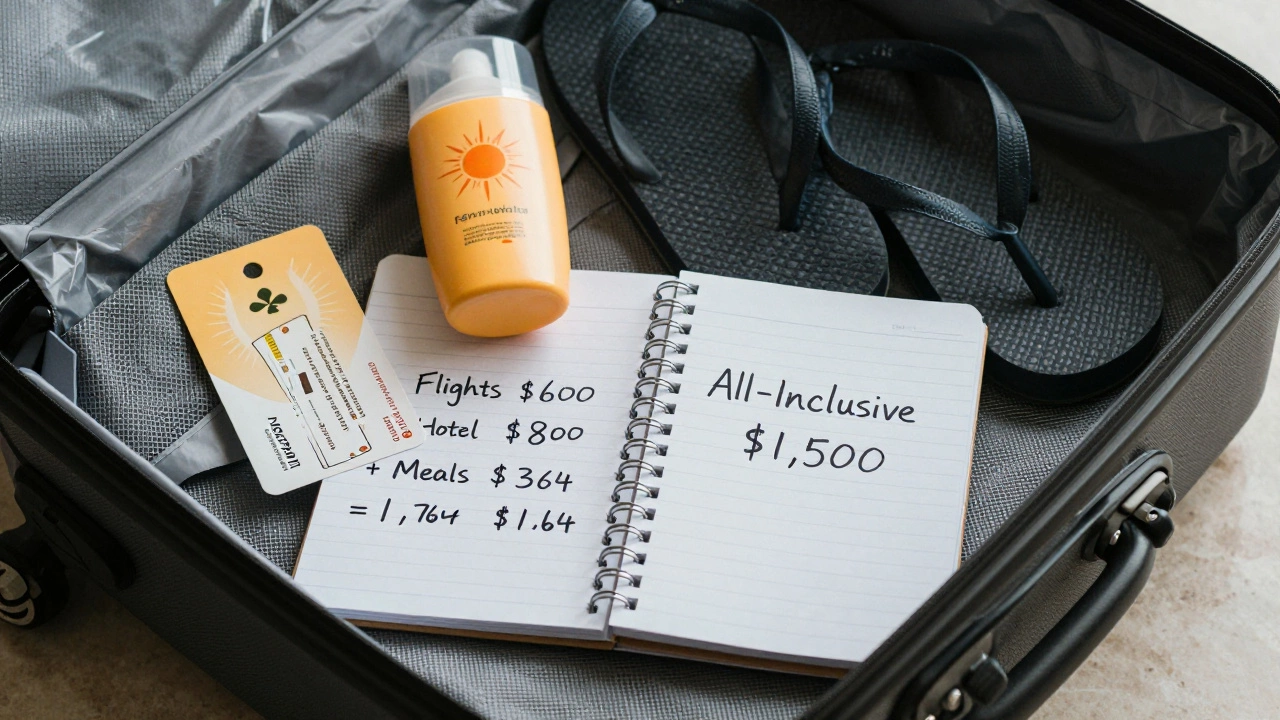
Let’s say you book a 7-night stay at a 4-star hotel in Jamaica for $800 total. Flights cost $600 round-trip. Now add food: breakfast at the hotel is $15, lunch at a local spot averages $12, and dinner at a restaurant runs $25. That’s $52 a day, or $364 for the week. Drinks? Two cocktails a day at $10 each? That’s $140. Add a snorkeling trip ($60) and a day trip to Dunn’s River Falls ($40), and you’re at $800 for extras.
Your total? $800 (hotel) + $600 (flights) + $364 (food) + $140 (drinks) + $100 (activities) = $2,004.
Compare that to an all-inclusive package at a similar resort: $1,500. At first glance, it looks like you saved $500. But if you didn’t use the premium restaurants or pay for extras, your actual spending on the non-all-inclusive trip might’ve been closer to $1,300. That means the all-inclusive wasn’t cheaper-it just made you spend more because it felt "included."
Who saves the most with all-inclusive?
Not everyone. Families with kids often benefit. Kids eat free, drinks are included, and there’s no need to hunt down restaurants or pay for babysitters. If your kids are eating three meals a day and you’re sipping margaritas by the pool, the math works. Resorts with kids’ clubs and family pools make this even easier.
People who drink a lot also save. A bottle of wine at a restaurant can cost $50. At an all-inclusive, you get unlimited house wine. If you drink two glasses a night, that’s $140 a week. In an all-inclusive, it’s $0 extra.
Travelers who hate planning love it too. No comparing prices, no checking menus, no worrying about exchange rates. You pay once and forget it. That peace of mind has value.

Where all-inclusive backfires
Here’s the trap: you pay upfront for everything, then don’t use half of it. Many people book all-inclusive because they think they’ll eat, drink, and party nonstop. But after two days, you’re tired of buffet food. You crave local cuisine. You want to explore the town. You end up skipping meals or eating room service because the options feel repetitive.
That’s what happened to Lisa from Ohio. She booked an all-inclusive in the Dominican Republic for $1,300. She ate breakfast and dinner at the resort, skipped lunch, and only had one drink per day. She didn’t use the spa, didn’t book any excursions, and never tried the steakhouse. She ended up spending $150 on a local food tour and $80 on a beachside lunch she couldn’t get at the resort. Her total? $1,530. She paid more than if she’d booked separately.
And let’s not forget the quality issue. All-inclusive resorts often serve food in bulk. Think lukewarm pasta, rubbery chicken, and over-sweetened cocktails. If you care about taste, you’re paying for convenience, not quality.
When to avoid all-inclusive
- You’re a foodie. You want authentic, local meals-not standardized buffets.
- You plan to explore. You’ll be out every day, not lounging on the beach.
- You’re traveling to a place with cheap, delicious food. Think Thailand, Mexico, or Vietnam.
- You’re on a tight budget and don’t drink alcohol. You’re paying for drinks you won’t use.
- You hate crowds. All-inclusive resorts are packed with other guests doing the same thing.
How to make all-inclusive work for you
If you’re considering it, here’s how to actually save money:
- Compare the total cost. Add up flights, hotel, meals, drinks, and activities you’d normally pay for. Then compare to the all-inclusive price. Don’t just look at the headline number.
- Check what’s included. Look for fine print: Is premium alcohol included? Are transfers covered? Is Wi-Fi free?
- Book early. All-inclusive deals are cheapest 4-6 months ahead. Last-minute deals are rare.
- Choose a resort with good food reviews. Don’t pick based on pool size alone. Read recent traveler comments about meals.
- Use the free stuff. Take advantage of included activities-snorkeling, yoga, cooking classes. That’s where the real value hides.
The bottom line
All-inclusive isn’t cheaper by default. It’s cheaper if you use what’s included. If you’re the type who eats three meals a day, drinks a few cocktails, and doesn’t mind buffet food, then yes-it saves money. But if you’re a curious traveler who wants to taste local flavors, walk through markets, or sleep in a boutique hotel, you’re better off paying as you go.
The real cost isn’t in dollars. It’s in experience. All-inclusive gives you predictability. But it also limits discovery. You’re not just paying for food and drinks-you’re paying for a bubble. And sometimes, the best parts of a trip happen outside it.
Is an all-inclusive vacation worth it for families?
Yes, especially for families with young kids. Kids eat free, meals are included, and resorts often have kids’ clubs, pools, and activities built in. You won’t need to book separate babysitters or hunt down kid-friendly restaurants. The upfront cost makes budgeting easier, and you avoid surprise expenses. For parents, the convenience often outweighs the lack of variety in food.
Do all-inclusive resorts charge extra for alcohol?
Most include basic beer, wine, and house spirits, but premium brands like Grey Goose, Macallan, or craft cocktails usually cost extra. Always check the drink list before booking. Some resorts offer upgraded drink packages for $15-$30 per day if you plan to drink heavily.
Can you leave the resort on an all-inclusive package?
Absolutely. You’re not locked in. Many travelers leave daily to visit local markets, restaurants, or attractions. Just be aware that meals and drinks outside the resort aren’t covered. Some resorts even offer discounts on excursions, so ask at the front desk.
Are all-inclusive resorts safe?
Resorts themselves are generally safe-they’re gated, have security, and cater to tourists. But safety outside the resort varies by location. Always check your government’s travel advisory before going. Stick to well-reviewed tours if you leave the property, and avoid walking alone at night.
What’s the best time to book an all-inclusive deal?
Book 4 to 6 months in advance for the best prices. Early spring (March-April) and late fall (October-November) often have the lowest rates. Avoid peak holiday periods like Christmas, spring break, and summer vacation. Last-minute deals are rare because resorts fill up fast.