
You’ve got a free weekend. The kids are off school. Your partner just said, "Let’s get away." And suddenly, you’re staring at your phone, wondering: do flight prices get cheaper closer to the date? It feels like magic-book at the last second, score a deal, vanish into the sunset. But is it real? Or just wishful thinking?
The short answer? Sometimes. But not how you think.
Why People Believe Last-Minute Flights Are Cheaper
It’s a myth that’s been passed around like a bad souvenir. You hear it from coworkers, see it in viral TikToks, read it in old travel blogs from 2018. The story goes: airlines panic when seats are empty, so they slash prices 48 hours out. It sounds logical. But logic doesn’t always match reality.
In truth, most airlines use dynamic pricing powered by AI. They track demand, competitor pricing, booking patterns, even weather forecasts. If a flight is filling up fast? Prices climb. If it’s sitting empty? They might drop prices-but not always, and not always by much.
Here’s what actually happens: the cheapest fares usually disappear within the first 2-4 weeks after a route opens. By the time you’re thinking about booking a trip for next weekend, the rock-bottom fares are already gone. What’s left? Middle-tier fares. Or, if you’re unlucky, the last few seats at full price.
When Prices Actually Drop (And When They Don’t)
There are exceptions. But they’re rare-and they follow patterns.
Flights that might get cheaper last minute:
- Midweek flights (Tuesday, Wednesday) on routes with low demand
- Flights to secondary airports (e.g., Ottawa instead of Toronto for a Florida trip)
- Overseas routes with inconsistent demand (like flights to Eastern Europe or parts of South America)
- Flights during off-season or bad weather windows (e.g., late November to early December in Canada)
But here’s the catch: even when prices drop, they rarely drop below what you could’ve paid if you’d booked 6-8 weeks ahead. And you’re gambling. What if no one cancels? What if the flight fills up? You’re stuck paying $600 for a seat that was $320 three weeks ago.
Real-world example: A Toronto to Cancún flight in early January 2025. Booked 8 weeks out: $410 round-trip. Booked 3 weeks out: $520. Booked 48 hours out: $580. No discount. Just higher prices.
The Real Window for the Best Deals
Studies from Hopper, Google Flights, and Airfarewatchdog show the sweet spot for domestic flights in North America is 1-3 months before departure. For international? 2-5 months.
Why? Airlines release their lowest fare buckets early. They’re designed to fill planes with price-sensitive travelers-students, retirees, remote workers-who plan ahead. Once those buckets are gone, the airline shifts to targeting business travelers and last-minute planners who pay more.
For Canada-specific routes, the pattern holds. Toronto to Vancouver? Best prices 60-90 days out. Montreal to Jamaica? 75-100 days. Even for short hops like Calgary to Phoenix, waiting until the last week almost always costs more.
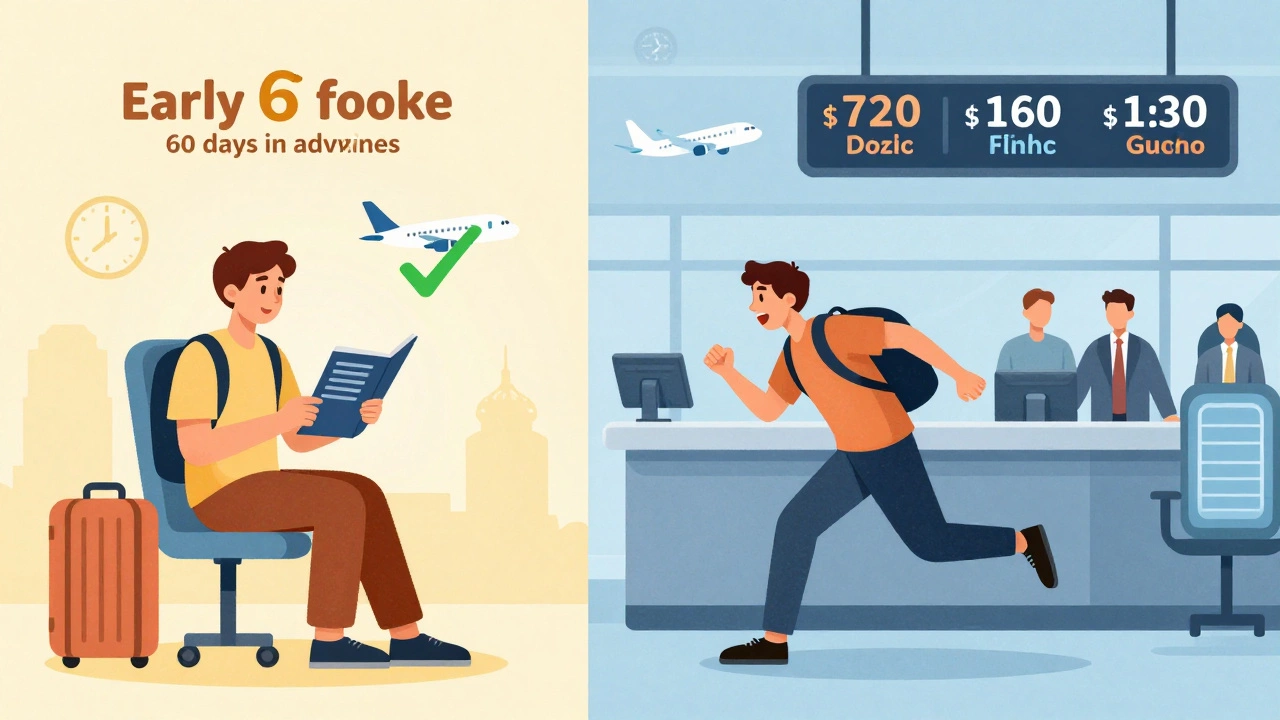
What Happens If You Wait Too Long?
Let’s say you’re thinking, "I’ll wait till Friday night-maybe something drops." Here’s what you’re risking:
- Higher prices: 82% of last-minute flights (within 7 days) cost more than the average fare for that route.
- Fewer options: You’re limited to whatever’s left-early morning flights, 3-stop connections, or flights with no seat selection.
- No flexibility: If your plans change, you’re stuck with non-refundable tickets that cost $200 to change.
- Stress: You’re racing against time, checking 10 apps, praying for a deal that might not come.
One traveler from Edmonton booked a last-minute flight to Los Angeles on December 20, 2025. She paid $710. A friend who booked the same flight on October 15 paid $380. Same airline. Same seat. Same date. The only difference? Time.
When Last-Minute Booking Actually Makes Sense
It’s not all bad. There are real cases where waiting works.
Scenario 1: You have a flexible schedule and live near a major hub. If you’re in Toronto and can fly any day next week, you might catch a deal on a Tuesday flight to Orlando that was overbooked. Airlines sometimes drop prices 72 hours out to fill empty seats-but you need to check constantly.
Scenario 2: You’re booking a flight with a low-cost carrier that has no change fees. Airlines like Flair or Swoop sometimes release surprise sales 1-2 weeks out. But you have to sign up for alerts and be ready to book in 10 minutes.
Scenario 3: You’re traveling during a known slow period. After Christmas, right after New Year’s, or during the week after Labour Day-these are times when airlines have extra inventory. Flights from Toronto to Mexico City in the first week of January 2025 were 30% cheaper than the same dates in December.

How to Spot a Real Last-Minute Deal (Not a Trap)
If you’re going to gamble, here’s how to do it smartly:
- Use price trackers: Set alerts on Google Flights, Hopper, or Skyscanner. Watch the trend for your route over the past 30 days. If prices have been steady or rising, don’t wait.
- Check the load factor: On Google Flights, look for the "% full" indicator. If it’s below 50% three days out, there’s a chance of a discount.
- Compare airports: Try flying from Hamilton instead of Toronto. Or Ottawa instead of Montreal. Sometimes the savings are worth the drive.
- Don’t fall for "Only 2 seats left!" That’s a psychological trick. Airlines show fake scarcity to push sales. Check the same flight on a different device or browser-often the message disappears.
- Always compare the total cost: Add baggage fees, seat selection, and change fees. A $299 flight with $120 in extras isn’t a deal.
The Bottom Line: Don’t Chase the Myth
Flight prices don’t magically drop the closer you get to departure. The idea that you’ll score a bargain by waiting is mostly a myth fueled by a few lucky stories and clickbait headlines.
If you want the best deal, plan ahead. Book 6-8 weeks out for domestic trips. 3-5 months for international. Use price alerts. Be ready to act when you see a good fare-not when you’re stressed and running out of time.
Last-minute flights aren’t a strategy. They’re a gamble. And in this game, the house always wins.
Still, if you’re flexible, tech-savvy, and willing to sacrifice comfort for savings, you might catch a rare deal. But don’t count on it. Your future self will thank you for booking early.
What to Do If You’re Already Late
It’s December 27. Your trip is tomorrow. You haven’t booked.
Here’s your real plan:
- Open Google Flights and search for your destination from all nearby airports (Toronto, Hamilton, Ottawa, Buffalo).
- Filter for non-stop only. Look at prices from today to tomorrow.
- If you see a fare under 20% above the 30-day average? Book it. Don’t wait.
- If all prices are above 50% higher than usual? Consider a train, bus, or even driving. Sometimes the ground option is cheaper and less stressful.
- Don’t book a hotel yet. Use apps like HotelTonight for last-minute stays. They often have better deals than flights.
You won’t get the dream deal. But you might still get away.
Do flight prices go down the day before?
Sometimes, but rarely. Airlines rarely drop prices the day before departure unless the flight is severely underbooked. Even then, the savings are usually under 15%, and you’re stuck with whatever seats are left-often in the back, next to the bathroom, or with no legroom. It’s not worth the risk unless you’re desperate.
Is it cheaper to book flights at night?
No. There’s no consistent evidence that booking at midnight or 3 a.m. gives you better prices. Airlines update fares based on demand, not time of day. What matters is how far in advance you book, not when you click "buy."
What’s the best day of the week to book a flight?
Tuesday and Wednesday are often the cheapest days to book, not because airlines lower prices then, but because fewer people search and book on those days. That means less demand, which can lead to slightly lower fares. But the difference is small-usually less than 5%. The bigger factor is still how early you book.
Can I get a refund if prices drop after I book?
Most airlines don’t offer refunds for price drops unless you bought a flexible fare (which costs more). Some, like Southwest, let you rebook without a fee and get the difference as travel credit. Always check the airline’s policy before booking. Don’t assume you’ll get money back.
Are last-minute flight deals real or just marketing?
Some are real, but they’re rare. Airlines do occasionally run flash sales 1-2 weeks before departure to fill empty seats. But these are usually advertised on their own websites or through email newsletters-not on third-party deal sites. If you see a "last-minute deal" on a blog or social media, check the dates and fine print. Often, it’s just an old promo or a fare that’s not actually available.
If you’re planning a trip, don’t wait. The best deals are already gone. The ones still around? They’re priced for people who don’t have time to wait.